
Home Blog

Mobile Grocery App Launch: The 11-Step Guide

0
Peter Nakamura, Product Marketing Manager, Mercatus

For regional grocers looking to compete with mass merchants by operating their own eCommerce experience, investing in a solution that’s convenient for your customers is critical. Today’s omnichannel shoppers love the convenience of shopping online and they have specific expectations. They’re looking for a mobile grocery app that is functional, easy-to-use, and smoothly translates the in-store experience online.

If your existing mobile app is failing to meet shoppers’ expectations, it may be time to consider launching with a brand new solution. Luckily, by combining the right technology with a savvy communications strategy and cross-channel operational excellence, grocers can now launch mobile apps easier than ever before.

Read on to uncover the comprehensive 11-step guide to launching (or relaunching) a mobile grocery app.

Mobile Grocery Shopping: The Future of Grocery eCommerce

Mercatus recently conducted a survey of 2,000 U.S. consumers to better understand their habits and preferences with respect to grocery shopping. Here were some of our findings.

40% of U.S. Consumers Use Pickup or Delivery Monthly

Grocery pickup and delivery services are redefining the retail sector. In fact, 40% of US consumers are using these services monthly. No more long lines, no more crowded stores. That’s why retailers are stepping up with more online solutions, giving consumers the freedom to shop from home. This shift is changing the game for both shoppers and retailers.

Pickup is the Preferred Method of Online Grocery Shopping
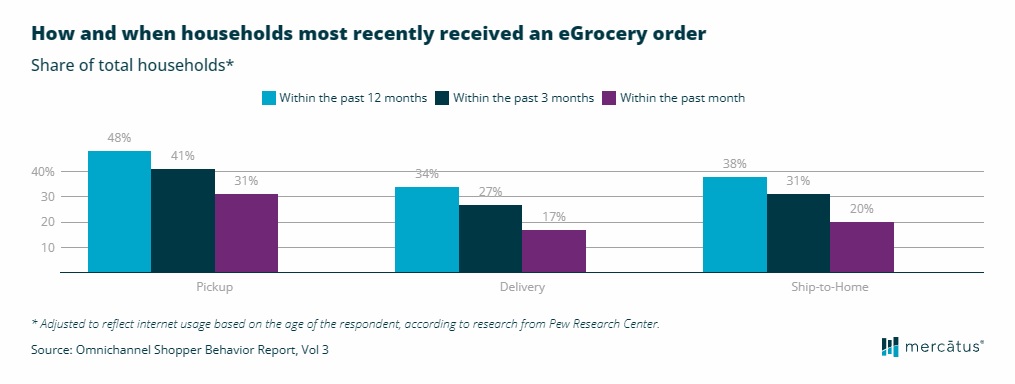
Though delivery was a popular choice in the peak of the pandemic, pickup is proving itself to be the preferred solution as consumers return to pre-pandemic shopping patterns. According to our study, 31% of U.S. households had used a pickup service within the last month, and nearly 50% within the last year.

Customers Rely on Mobile Apps to Complete Grocery Pickups
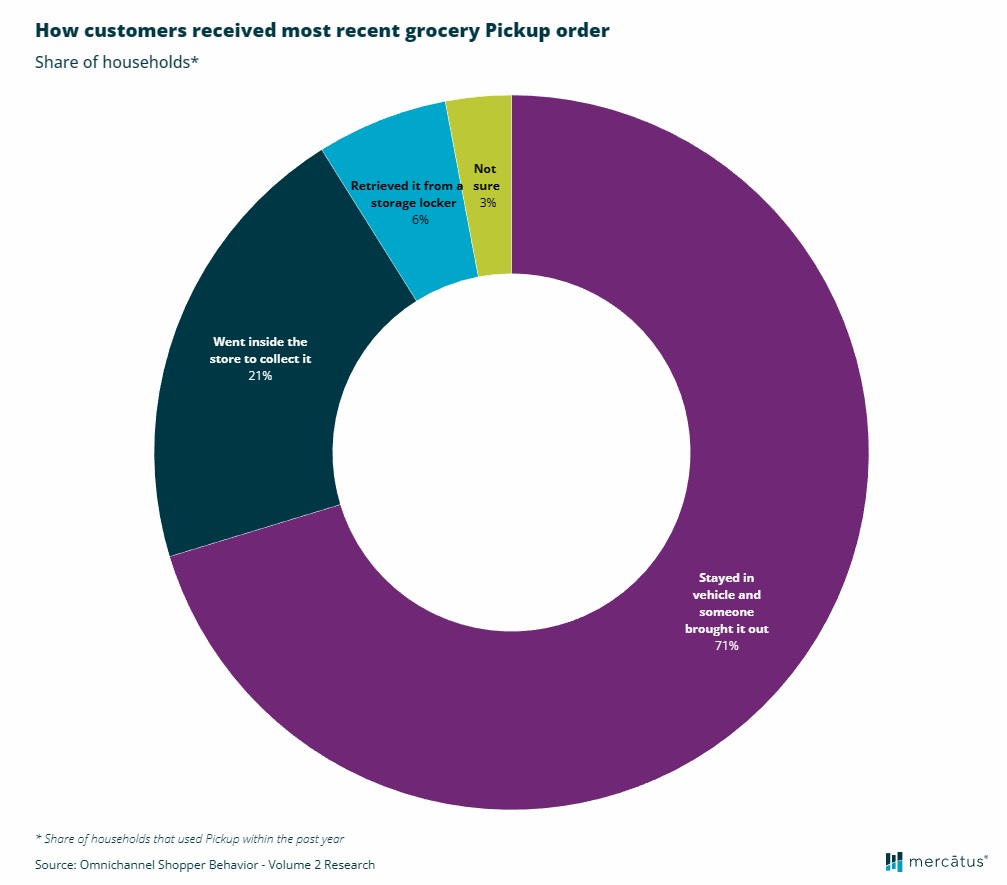
Among online grocery shoppers that use pickup services, 71% received their order delivered to their car and 48% of those customers notified the store of their arrival via the retailer’s mobile app. That tells us that not only are retailers embracing mobile technologies, but that shoppers are keen to adopt these
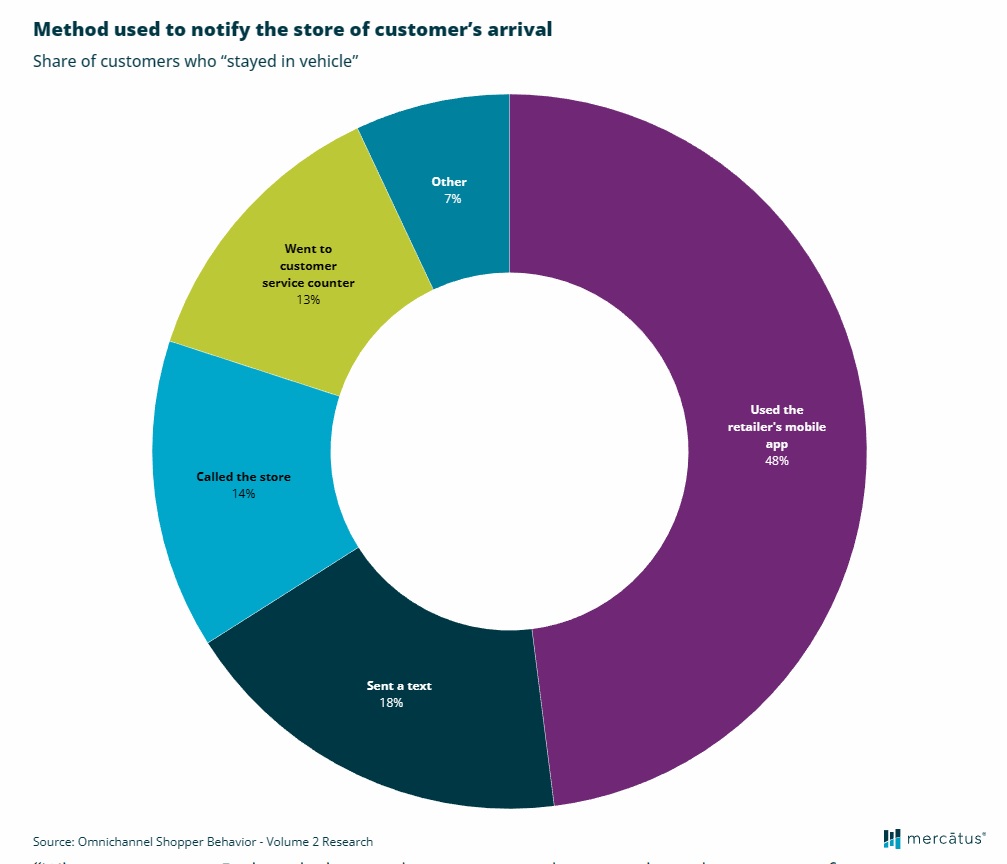
“When it comes to Pickup, linking order staging readiness with geolocation notifications triggered automatically by the retailer’s branded mobile app is an effective way to streamline the Pickup experience into a faster, hassle-free experience. Shorter wait times at Pickup can have a dramatic effect on customer perception and brand affinity and will go a long way to encouraging repeat customer behavior. ” – Sylvain Perrier, President and CEO, Mercatus.

The 11-Steps to Launching a New Grocery eCommerce Mobile App

So you probably get it—online grocery shopping isn’t going away. Grocery shoppers are getting more and more comfortable with the convenience of placing grocery orders from the comfort of their mobile devices. That’s why grocery retailers need to ensure that they are making it easy for those mobile app transactions to occur.

Whether you’re a grocery retailer with an existing mobile app that’s going out of style or you’re looking to pioneer your first-ever mobile eCommerce platform—you’re going to need a plan of attack. Follow these 11 steps to ensure that your implementation is successful.

Pre-Launch Activities

Pre-launch activities set the stage for a killer app launch. From creating buzz to refining the user experience and everything in between, these steps are crucial to success. In this section, we’ll guide you through the musts for a successful grocery eCommerce mobile app launch. Get ready to learn and launch with confidence!

1. Contact Your Existing eCommerce Platform Provider

If you’re migrating from one eCommerce platform to another, it’s important that you inform your existing provider that you’re migrating well ahead of your launch. Most providers will cooperate with your migration process and export essential data such as your customer database and content files. In addition to these files, you’ll need to make sure you get access to your app’s Apple Developer Account (iOS) and Keystore (Android) if you don’t already have it. Your new provider will be able to provide a full migration checklist so make sure you speak to their technical team to get a head start on collecting all the necessary information.

If your existing provider is slow to support or even blocks you from doing so, you may need to release a new app on the Apple Store or Google Play. If this is the route you have to pursue, it’s critical that you plan a robust marketing campaign (see more on this topic in Step five – Build a Communications Strategy) and leverage in-app notifications in the existing app to notify customers about the transition process as they will have to find and download the new app.

2. Know Your Target Audience

It is essential that regional grocery stores understand the shopping habits of their consumers so that they can tailor the mobile experience to meet (and exceed) their needs. The best way to understand your audience is by analyzing both first and third-party data.

First-party data is any information that you have on your customer base, be it:

  • Customer name and contact information (email, phone number)
  • Purchase history and buying patterns
  • Loyalty program information and rewards
  • Demographic information (age, gender, income, location)
  • Feedback and surveys responses

Third-party grocery data can be sourced from industry associations or research firms like Brick Meets Click that help grocers make more informed strategic decisions. For example, the monthly Brick Meets Click/Mercatus Grocery Shopping Survey collects deeper insights than what might be available to most grocers, and serves as a waypoint or guide on topics such as:

  • Providing a more complete picture of eGrocery trends
  • Focusing on key business questions for grocery retailers
  • Examining household behaviors of primary grocery purchaser
  • Analyzing grocery spending, both instore and online
  • Measures online buying behaviors, like purchase recency, order frequency, formats shopped, and dollars spent
  • Monitoring the most recent experiences, like format shopped, amount spent, method used to receive order, past-usage history, and measures of satisfaction.

Use a combination of first and third-party data to determine what features your customers are looking for in a mobile app so that you can build a delightful online shopping experience.

3. Define Your App’s Value

If you are making the decision to transition to a new mobile grocery app or replace an existing one, then you need to be able to clearly articulate the answer to these four questions:

1. Where does your existing mobile app fail to meet customer needs?

When it comes to grocery apps, it’s critical that yours delivers exceptional value in 4 areas: seamless shopping, personalization, rewards & loyalty, and feature innovation.

Seamless shopping should be at the core of every app. From cart building to the checkout process, the app experience should be as frictionless as possible. Personalization is how well the content in the app reflects the preferences and interests of the individual customer. Great grocery apps should be focused on serving product recommendations, search functionality, and shopper profiling.

Part and parcel with personalization is rewards & loyalty. Offering a robust loyalty program encourages app adoption and will help increase share of wallet. And finally, feature innovation is how often you’re releasing new upgrades to improve the customer experience. The underlying architecture of your app should make it easy to develop new features to stay ahead of the competition.

2. What features and functionalities will you upgrade with the new app?

Based on your assessment of the first question, you’ll be in a good position to determine where your app experience can be improved. Are there improvements you’d like to make say with the cart building or checkout process? Is personalization an area that you’d like to improve? Will you be re-introducing your loyalty program as part of your launch? Or are there net new features your customers have been consistently requesting?

The important part here is that the product development team has a clear roadmap and prioritization of the features that will deliver the greatest value for the business and your customers.

3. What benefits does the new app offer your business?

From a business standpoint, the overarching goal for your mobile app should be to help drive brand affinity and customer lifetime value as we know that omnichannel shoppers spend more with your brand than single-channel shoppers. Increased average order value (AOV), more frequent repeat purchases, and an overall increase in share of wallet and mobile channel revenue are a few benefits – among others – an improved app experience should bring to your business.

4. What benefits does the new app offer your customers?

Grocery shopping has become an “always-on” experience. Customers might start a basket on Wednesday morning, adding items as they might to a running shopping list, placing their order on Friday night, and schedule pickup on Saturday afternoon. Every step of the way, the app experience should be making it easy for customers to build their baskets, discover relevant products, and checkout with a pickup or delivery option that’s most convenient to them.

4. Optimize Your App for Engagement, Conversion, & Retention

If you are replacing your existing app or mobile shopping experience, then your objective should be to improve in-app engagement, conversion rates, and customer retention.

Use these tactics to optimize your mobile grocery app for engagement, conversion, and retention:

  1. Stellar design. Make your app visually stunning and easy to navigate.
  2. Deep personalization. Offer customized recommendations and deals based on shopping behavior.
  3. Listen to the masses. Encourage user feedback and respond to their wants and needs.
  4. Lightning-fast checkouts. Make checkout fast and secure, with multiple payment options.
  5. Inventory updates. Minimize substitutions by keeping inventory data fresh.
  6. Incentivize repeat purchasing. Offer rewards, discounts, and loyalty programs for repeat purchases.
  7. Notify with purpose. Use push notifications for new arrivals, sales, and promotions.

Take your mobile grocery app to the next level with these tactics and watch your engagement, conversions, and retention climb.

5. Build a Communications Strategy

As you prepare for the launch of your mobile grocery app, there is a lot of work to be done to ensure that your audience is aware of the new platform.

  1. Segment your target audience based on demographics or behaviors. Identify the age, gender, location, and interests of various subsets of your target audience, as well as their shopping habits so that you can hyper-target your campaigns.
  2. Determine launch campaign objectives. What are the goals of your communication strategy? Are you aiming to drive app downloads, increase brand awareness, attract new customers, or otherwise?
  3. Choose your promotional channels. Some of the best channels to use to promote your eGrocery app are in-store signage, both the print and digital versions of your flyer, grocery bag tip-ins, outdoor signage (in the parking lot, at the entrance) push notifications (if you have an existing app), email communications, website content, and more. Your strategy for social channels should include organic and paid, but also user generated content with influencers within your target audience.
  4. Develop messaging. Craft a clear and concise message that highlights the key features and benefits of your app. Be sure to emphasize how seamless the transition will be from the old app and shopping experience to the new one.
  5. Create content. Develop engaging graphics, banners, videos, tutorials, and product demos that showcase your app and its unique selling points.

As mentioned in Step one, if your current eCommerce platform provider is making it difficult to migrate your existing app, you will need to adjust your communications strategy to address this change. For your customers, the transition from one app to another needs to be as seamless as possible. You will need to develop messaging around new key features and the benefits they will provide over the previous app. Finally, you will need to get your messaging across through the appropriate channels, such as push notifications on the previous app informing customers about the new one.

6. Define Metrics to Measure Success

Once you’ve completed your comms strategy, you will need to create a list of KPIs that will help you measure the success of your app launch.

The most important metrics to monitor include:

  • User acquisition:
    • The number of download
    • Sources of traffic
    • Installs
  • User engagement:
    • DAU (daily active users)
    • WAU (weekly active users)
    • MAU (monthly active users)
    • Session length
    • Retention rate
  • Revenue generated:
    • Cart conversions
    • Average order value
    • Retail media revenue
  • User Feedback. Reviews, ratings, and customer surveys.
  • Performance. App crashes and usability issues.
  • Technical Issues. Server response time, API errors, payment failures.

Note for grocers with an existing mobile app: Grocers that are replacing an existing mobile app need to keep an especially close eye on their DAU, WAU, and MAU on both the old app and the new app. The percentage of users that make the migration is a leading indicator of the success of your new app launch. Specific migration rates can vary largely depending on the type of app, the user base, the reasons for migration, the quality of the new app, and the transition process—generally resulting in a migration rate of anywhere from 20% to 70%. Since grocery apps are indispensable for customers and are typically used on a weekly cadence to coincide with the weekly grocery visit, it’s critical that DAU and WAU are tracked carefully.

It’s also important to establish feedback loops so that data on mobile app performance can easily be collected, analyzed, and used to inform your ongoing promotional strategy, development roadmap, and more.

Mercatus Console makes it easy to aggregate performance data on your mobile app at a store level or across a number of locations. And if you’re looking to mine insights from your data, Mercatus’s dedicated customer experience team is here to help. Explore Mercatus Mobile today to learn more about the leading native mobile grocery app in the industry.

During Launch Activities (Month 1)

Ready for lift-off? This section covers the must-dos during the launch of your mobile grocery app. From launching your marketing strategy to collecting customer feedback, these steps will help you ensure a successful launch.

7. Launch Your Communication Strategy

It’s time to flip the switch on all of the programs that you mapped out in the pre-launch phase of your journey. Some of these programs will require more active management, while others will require less effort, but It’s important to review the campaign and identify the best performing channels and messaging. Having the capacity to redirect funds and update upcoming channel communications with the messaging that is resonating with the audience will increase conversion.
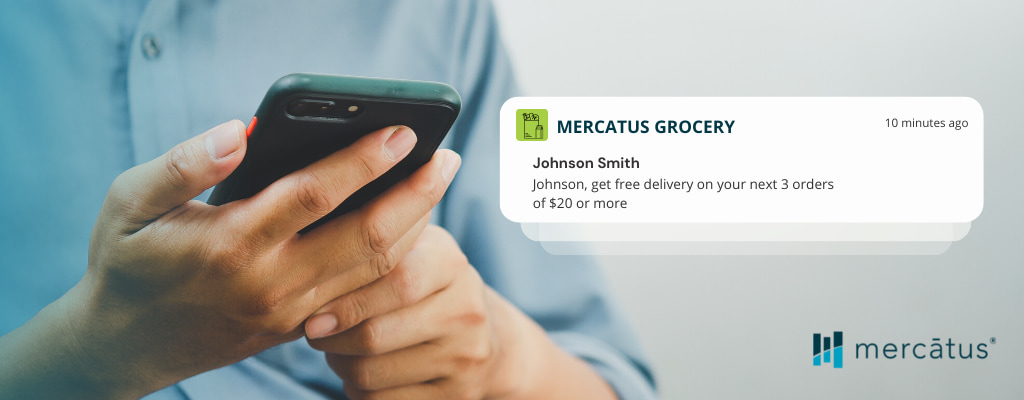
Mobile grocery app user receiving a notification about a new deal on their phone

8. Incentivize Customers to Use the New App

Some customers will be more inclined to adopt your new mobile grocery app, while others may be more hesitant. It’s important to note that there are many incentives for why a customer would consider trying a new or different mobile grocery app or service. However, not all those incentives are ones that retailers can use to persuade customers to try their app or service.

Our research on grocery pickup and delivery adoption determined that some of the most effective incentives that grocers can implement include $20 off the first order of $75 or more, or paying no fee for your first three orders. While the first promotion will persuade a potential customer to consider making a single order, the other will encourage them to try out the app at least three times. According to research conducted by Brick Meets Click, the likelihood of a customer reusing a service increases with every use, after four times the rate is approximately 85%.

During the launch of your app, consider encouraging potential shoppers to repeatedly use your pickup or delivery services through incentives that stretch for multiple orders. If successful, customers are highly likely to keep coming back to the app, adopting it into their lifestyle. Consider using the following controllable tactics to boost the adoption of your new mobile app.https://datawrapper.dwcdn.net/2aL3d/1/

9. Collect Customer Feedback

“The customer is always right.” The old adage is especially true when it comes to app development. Collecting early feedback allows you to be adaptive and responsive in the first month of the launch, but you should continue to actively encourage and collect feedback through at least the first six months after app launch.

Mercatus Mobile comes with a built-in feature to help grocers collect and monitor app feedback. It’s called Integrated Voice of the Customer, and here’s how it works:

  1. After a new user submits an order, they will be asked if they love the {insert company} app.
  2. If the new user selects “Yes,” they will be prompted to leave a rating and a review which will automatically be linked to either the App Store or Google Play Store.
  3. If the user chooses “No,” they will be provided with a feedback form so that they can offer more details.

This feature is invaluable to grocers for two reasons. Firstly, it allows you to quickly and easily collect customer feedback that can be used to make timely app revisions. Secondly, it makes it almost effortless for your loyal fans to leave rave reviews and positive ratings for your app.

One Mercatus client has been able to grow their review volumes significantly on Android and iOS while also maintaining a 4.8+ star rating on both platforms. That’s the power of Integrated Voice of the Customer.

Post-Launch Activities (Month 2 and Beyond)

Post-launch is make or break for your grocery eCommerce app. Monitor performance, gather user feedback, update, and promote to drive adoption and revenue. This section covers the key post-launch activities to ensure ongoing success.

10. Retain Users & Expand App Usage

Once your mobile grocery app is live, it’s time to focus on retention and expansion. Our data shows that the first 15 days after the initial mobile eCommerce sale are mission-critical in determining customer retention. If you can drive a second purchase within that period, retention rates climb dramatically.

The following tactics can improve user retention rates:

  • Seamless onboarding. Streamline the sign-up and onboarding process to make it quick and user-friendly.
  • Personalization. Offer a personalized product search experience based on each user’s shopping history.
  • Incentives. Offer incentives such as discounts or loyalty points to encourage users to keep coming back.
  • User engagement. Use push notifications, email marketing, and other forms of communication to keep users engaged and informed about new products and deals.

Okay—you’ve successfully made yourself a swath of loyal customers. Now it’s time to start thinking about how you can expand the revenue from mobile accounts while also reducing your fulfillment costs.

The following tactics can help you expand mobile grocery revenue:

  • Retail Media. Sell product placements to customers to help offset the costs of your mobile grocery program.
  • Cross-selling and upselling. Suggest complementary or higher-priced products to customers during the checkout process.
  • Private-label products. Promote your private-label products with higher margins and lower price points to attract cost-conscious consumers.
  • Customer loyalty programs. Loyalty programs benefit customers, but they also help retailers as they encourage the formation of repeat and regular purchase patterns. In fact, 86% of US respondents said a loyalty program motivates them to buy again from a brand.

11. Monitor Feedback and KPIs

The final step in ensuring the long-term success of your new mobile grocery platform is keeping a keen eye on the KPIs identified in step six as well as all inbound customer feedback. Dips in usage rates and other key mobile app metrics can be powerful predictors of future shopping behavior and reviews can yield insights that can help you make adjustments and improvements to the mobile shopping experience.

mobile grocery app user leaving a review

Retailers must continuously keep up with KPI monitoring and customer feedback, in order to meet the evolving demands of the omnichannel shoppers. This includes integrating promotions and communications across in-store and online with long term marketing programs. Partnering with the right tech providers will ensure that your app is constantly receiving innovative updates, improving the overall user experience for your customers.

Mercatus Mobile: The Leading Mobile Grocery App for Retailers

Mercatus Mobile is the leading native mobile grocery app for grocers that want to foster a seamless white-label mobile shopping experience.

Mercatus Mobile gives users the power to increase average order values, increase order frequency, and deepen customer loyalty through a sophisticated, but easy-to-use interface.

New features in our next-gen mobile format include:

  • Redesigned coupons. Use advanced behavioral data to serve customers with digital coupons at exactly the right time to increase savings, increase basket size, and foster deeper brand affinity.
  • Interactive flyers. Mobile flyers have never been so fun. Provide a more engaging online experience and drive more sales with interactive flyers, built on the Flipp SDK.
  • Digital loyalty cards. Put loyalty front and center by giving app users access to their digital loyalty card right from the navigation bar.

If you’re ready to deliver your customers the next-generation mobile shopping experience that they deserve, then contact Mercatus to schedule a tour with the product experts.


Peter Nakamura is responsible for product marketing at Mercatus and educates grocery retailers about the latest platform innovations.

How to Tackle Key Fragrance Shipping Pain Points for e-Commerce Brands

0
Douglas Longobardi, Chief Revenue Officer, Asendia USA

Fragrance is a fast-growing and profitable category in cross-border global e-commerce, but shipping these products internationally comes with unique challenges. Alcohol-based ingredients, fragile packaging, and regulatory requirements add complexity to the shipping process, which can affect both delivery reliability and customer satisfaction.

Understanding these common shipping pain points can help e-commerce brands reduce disruptions and optimize international deliveries.

Dangerous Goods Compliance

Many perfumes contain alcohol, classifying them as flammable liquids under international shipping regulations. Online retailers shipping fragrances should work with a cross-border shipping provider that is experienced in shipping fragrances so they can help ensure these products meet all dangerous goods requirements, from correct classification to proper packaging. Fragrances are commonly classified as UN1266 – Perfume Products (Hazard Class 3).

Improperly classified shipments can face delays, rejection by carriers, or customs issues. Shippers must also ensure proper documentation, training certification, and carrier approval for dangerous goods shipments. Following dangerous goods protocol ensures smoother transit and fewer disruptions.

Packaging and Leakage Risks

Fragrance products are often packaged in glass bottles, making them vulnerable to breakage or leakage. It’s recommended that e-tailers use durable, protective packaging solutions to safeguard shipments during international transport.

Dangerous goods shipments may require UN-certified packaging with absorbent material, leak-proof inner containers, and tested outer cartons designed for hazardous materials transport.

This reduces the risk of product damage, protects other shipments in the same consignment, and maintains a high standard of delivery reliability.

Documentation Errors

Accurate documentation is critical for international shipping. Errors in classification codes, customs paperwork, or product details can delay shipments at the border.

Dangerous goods shipments must also follow specific labeling requirements, including flammable liquid hazard labels, proper UN number markings, and orientation arrows for liquid shipments.

It’s recommended that e-commerce brands partner with a global shipping provider that provides guidance on proper documentation and customs compliance, helping shipments clear quickly and reducing costly delays.

Higher Shipping Costs

Fragrance shipments often require specialized packaging, compliance measures, and extra handling. These factors can increase costs compared to standard e-commerce products.

Many e-commerce fragrance shipments operate under “Limited Quantity” programs, which can simplify labeling and documentation when bottle sizes and shipment weight fall within regulatory thresholds.

Planning ahead with the right global shipping partner allows businesses to account for these expenses while maintaining reliable operations and avoiding unexpected reshipping costs.

Impact on Customer Experience

Shipping delays, damaged products, or unexpected fees directly affect customer satisfaction and brand trust. Delivery disruptions can also lead to customer credits, reshipping costs, and reduced customer loyalty or repurchase rates.

By partnering with a global shipping provider that can address these challenges early, e-commerce brands can build a dependable international shipping strategy that delights customers and supports long-term growth.

Key Takeaways

By proactively addressing these shipping challenges, e-commerce brands can minimize delays, reduce product damage, and control costs, all while delivering a seamless experience to their customers.

Asendia USA’s trade compliance expertise, including support for Canada-bound shipments, helps ensure regulatory requirements are met and cross-border deliveries move smoothly.

Partnering with Asendia USA provides expert guidance, reliable logistics solutions, and compliance support to help brands confidently ship fragrances internationally and grow their global presence.


Douglas Longobardi is Chief Revenue Officer at Asendia USA, a global leader in international e-commerce and mail delivery across 220+ destinations. He joined Asendia following its acquisition of Globegistics, a company he co-founded in 2011 and scaled to $75 million in revenue. Prior to that, he spent 11 years as Sales Director at WorldNet Shipping. With over 25 years of experience, he brings deep expertise in cross-border e-commerce and global logistics strategy.

How to Ship Fragrance Internationally: A Step-by-Step Overview

0
Douglas Longobardi, Chief Revenue Officer, Asendia USA

Fragrance is one of the most popular product categories in global e-commerce, but it can also be more complex to ship than many other items. Many perfumes contain alcohol, which means they are classified as flammable liquids and subject to dangerous goods regulations. Because of this, retailers must carefully manage packaging, labeling, documentation, and destination requirements when shipping fragrances internationally.

For many U.S. e-commerce brands, Canada is often one of the first international markets they expand into. While cross-border shipping between the United States and Canada is common, fragrance products can introduce additional regulatory and shipping considerations.

For e-commerce brands expanding into new markets, following a clear process can help reduce delays and ensure shipments reach customers safely. With the right preparation and the support of experienced logistics partners, brands can confidently ship fragrance products to customers around the world. Asendia USA, together with its Canada trade compliance team, helps fragrance shippers navigate cross-border regulatory and compliance requirements.

Follow the steps below to help ensure your fragrance shipments reach their destination.

1.  Confirm the Product Classification

The first step is confirming how the fragrance is classified. Many perfumes contain a high percentage of alcohol, which can place them under flammable liquid classifications. This affects how the product must be packaged, labeled, and transported.

Fragrances are commonly classified as UN1266 – Perfume Products under Hazard Class 3 (Flammable Liquids). A Safety Data Sheet (SDS) is typically required to confirm the correct hazard classification, flash point, and handling requirements.

Misclassifying fragrance as a standard cosmetic product can lead to rejected shipments or compliance issues. Reviewing product ingredients and applicable regulations early in the process helps prevent these problems.

2.  Choose the Right Shipping Method

Once the classification is confirmed, retailers must determine which shipping services can support fragrance products. Some transportation methods restrict flammable liquids, and regulations may vary depending on the destination country.

Dangerous goods restrictions can limit available transport options, particularly for air shipments. Some services or transportation modes may not allow flammable liquids, while others may require specific handling procedures.

In many cases, shippers must also complete dangerous goods training certification (such as IATA Dangerous Goods Regulations for air shipments) and receive carrier approval before shipping fragrance products classified as hazardous materials.

Selecting a shipping method that complies with both dangerous goods regulations and destination country requirements is essential to prevent shipment refusals or transit disruptions.

3.  Use Secure Packaging

Perfume bottles are usually made of glass and contain liquid, which makes them more vulnerable during transit. Without proper protection, bottles can break or leak.

To meet dangerous goods regulations, many fragrance shipments require pre-approvedpackaging designed to safely contain flammable liquids. This packaging typically includes:

  • Secure inner containers
  • Protective cushioning materials
  • Secondary containment to prevent leakage
  • Durable outer packaging

Dangerous goods shipments often require UN-certified packaging that has been tested for transporting flammable liquids and includes absorbent material and leak-proof inner containers.

Proper packaging helps protect the product, reduces the risk of spills, and ensures compliance with shipping regulations.

4.  Prepare Accurate Documentation

International shipments require clear and accurate documentation to move smoothly through customs. Fragrance shipments often require detailed product descriptions and proper classification codes in addition to standard customs paperwork. Depending on the product classification and destination, documentation may include:

  • Dangerous goods declarations
  • Accurate HS codes for fragrance products
  • Detailed product descriptions
  • Customs documentation required by the destination country

For air shipments, shippers may also need to complete a Shipper’s Declaration for Dangerous Goods outlining the UN number, hazard class, quantity, and packaging instructions.

Errors or missing information can lead to delays or shipment holds, so careful documentation is essential.

5.  Understand Duties and Taxes

Import duties and taxes may apply depending on the destination market and product classification. These charges can affect the final cost of the order once it reaches the customer.

Understanding potential fees ahead of time helps retailers provide more transparent pricing and avoid unexpected charges during delivery.

Considerations When Shipping Fragrance to Canada

Canada is an important cross-border market for many United States retailers. However, fragrance shipments entering Canada must comply with Canadian import regulations and may require specific packaging and documentation.

Retailers should also consider duties and taxes that may apply to fragrance products entering the Canadian market. In some cases, postal networks may limit shipments containing flammable liquids, which can affect delivery options.

Preparing shipments carefully and understanding Canadian requirements in advance can help ensure smoother cross border deliveries.

Asendia USA operates a dedicated trade compliance organization supporting Canada-bound shipments, helping ensure shipments meet regulatory requirements before entering the Canadian market.

Logistics providers such as Asendia USA support e-commerce retailers with global delivery networks and cross-border shipping expertise.rce retailers with global delivery networks and cross-border shipping expertise.


Douglas Longobardi is Chief Revenue Officer at Asendia USA, a global leader in international e-commerce and mail delivery across 220+ destinations. He joined Asendia following its acquisition of Globegistics, a company he co-founded in 2011 and scaled to $75 million in revenue. Prior to that, he spent 11 years as Sales Director at WorldNet Shipping. With over 25 years of experience, he brings deep expertise in cross-border e-commerce and global logistics strategy.

Walmart Mexico Expands Strategic Partnership with Vusion to Deploy Connected Store Platform

0
Walmart Express Mexico

Walmart de México y Centroamérica, the largest retailer in Mexico, is expanding its collaboration with Vusion, the global leader in AI-powered digitalization solutions for physical commerce, to deploy the EdgeSense connected store platform across its Walmart Express stores and begin the transformation of its Supercenter fleet.

This initiative builds on the growing global collaboration between Walmart and Vusion, following the successful deployment of Vusion’s connected store technologies across Walmart US stores. The expansion reinforces Vusion’s role as a strategic technology partner supporting Walmart’s connected store transformation.

Under this agreement, Walmart Express stores will be fully deployed with EdgeSense technology by the end of 2026, marking the first large-scale rollout of the platform in Latin America. Following this phase, Walmart Mexico also plans to expand the deployment to Walmart Supercenters, significantly accelerating the company’s digital store modernization strategy.

Across the initial deployment, Walmart Express stores will be equipped with more than 1.7 million electronic shelf labels and over 180,000 EdgeSense smart rails, creating one of the largest connected store technology deployments in Latin America.

Walmart Mexico will also begin a pilot deployment in its Bodega format, evaluating how EdgeSense technology can support additional store formats as part of the company’s long-term connected store strategy.

EdgeSense is Vusion’s next-generation connected store platform, combining intelligent shelf infrastructure, computer vision, artificial intelligence (AI), electronic shelf labels, and real-time retail data to create a unified operating system for physical stores. The platform enables retailers to automate store operations, improve inventory accuracy, and unlock new data-driven capabilities across merchandising, and shopper engagement.

Through this initiative, Walmart Mexico aims to:

  • Deliver a more personalized and seamless customer experience
  • Improve associate productivity through workflow automation and reduce manual tasks
  • Modernize stores with AI-ready infrastructure to support future innovation

“The deployment of EdgeSense will help us further modernize our store operations and empower our associates to focus on serving customers,” said Paul Lewellen, Chief Operating Officer of Walmart de México y Centroamérica. “This initiative represents an important step in strengthening our operational capabilities while continuing to improve the shopping experience for millions of customers across Mexico.”

Philippe Bottine, Deputy CEO and EVP Vusion Americas, highlighted the strategic importance of the expansion: “We are very excited that Walmart is expanding its relationship with Vusion to Walmart Mexico. The rollout of EdgeSense across Walmart Express stores and the planned expansion to Supercenters represent a major milestone in our shared vision of building the connected store of the future. By combining AI, computer vision, and real-time data, EdgeSense helps retailers achieve new levels of operational excellence while delivering better experiences for both associates and shoppers.”

With this deployment, Walmart Mexico becomes the first retailer in Latin America to deploy EdgeSense at scale, positioning the company as a leader in retail innovation across the region.

ALDI U.S. Debuts New Nationwide Digital Experience Using Instacart’s Enterprise Technology

0
ALDI U.S. Debuts New Nationwide Digital Experience Using Instacart’s Enterprise Technology

Instacart (Nasdaq: CART), the leading grocery technology company in North America, and ALDI U.S., America’s fastest-growing grocer, today launched a redesigned ALDI U.S. website, aldi.us, and mobile app. The enhanced experience offers a more seamless, personalized way for customers to shop their favorite ALDI products online, powered by Instacart’s Storefront Pro enterprise commerce platform and fulfillment solutions. Instacart first began powering fulfillment for ALDI U.S. in 2019, and is now the retailer’s exclusive fulfillment partner across their website and app.

“ALDI is known for offering their customers incredible value, and we’re proud to partner with them to make sure that value translates seamlessly into their digital experience,” said Ryan Hamburger, Vice President of Commercial Partnerships at Instacart. “What makes this partnership special is that it goes beyond ecommerce. By combining Storefront Pro and fulfillment into one integrated platform, we’re helping ALDI U.S. scale faster while preserving everything that makes their brand special. We’re proud to deepen our partnership and support their continued expansion across the U.S.”

“Shoppers define value in more ways than one — often by saving both time and money,” said Dave Rinaldo, Chief Operating Officer at ALDI U.S. “As customers look for more flexibility, our partnership with Instacart enhances the ALDI online experience, giving the 1-in-3 U.S. households that shop our aisles another convenient way to get their groceries when and how they want.*”

Powered by Instacart’s Storefront Pro enterprise commerce platform and fulfillment solutions, the ALDI U.S. website and app deliver better personalized product recommendations, enhanced product discovery, and expanded meal planning support through shoppable recipes. Since 2019, Instacart’s fulfillment solutions have powered high- quality delivery and curbside pickup for ALDI customers in as fast as an hour on their owned and operated platforms, and customers can continue to count on that same speed and reliability with Instacart as their exclusive fulfillment partner.

ALDI and Instacart first partnered in 2017 to offer same-day delivery to ALDI customers on the Instacart Marketplace in the U.S. Since then, ALDI has deployed several other solutions to connect its online presence and in-store experiences and fulfillment technology across its more than 2,600 stores nationwide.

Instacart Storefront Pro is an enterprise-grade grocery solution that unifies a retailer’s website, mobile app, and in‑store digital touchpoints into one platform, combining AI-powered discovery and integrated fulfillment. Paired with Instacart’s fulfillment technology, it delivers an end-to-end owned ecommerce solution. Together, they are part of the Instacart Enterprise platform, a suite of integrated software and hardware solutions that connect in‑store and online grocery and help retailers like ALDI maintain full control of their brand and customer experience without managing fragmented ecommerce systems. ALDI joins more than 380 grocery retailers that use Instacart’s Storefront technology to power and scale their digital e‑commerce presence.

The new ALDI website and app are available now across the United States. Customers can visit aldi.us or download the ALDI mobile app for iOS and Android.

Wildfire Systems to Power Affiliate Monetization for Credit Key’s B2B Marketplace

0

Wildfire Systems Inc., an innovative financial technology platform that powers loyalty and reward programs and shopping companions, today announced that Credit Key, a B2B payments and financing platform, has partnered with Wildfire to power monetization for the transactions originating from its growing B2B marketplace.

Digital marketplaces are rapidly becoming the primary channel for B2B commerce. Industry data shows marketplace platforms account for approximately 65% of B2B ecommerce market share, representing an estimated $21.3 trillion in annual transaction value. With typically higher average order values than consumer transactions, B2B marketplaces present significant revenue opportunities for both merchants and platform operators.

Through the partnership, Credit Key is integrating Wildfire’s top merchants who service a B2B audience, including brands such as Sam’s Club, Best Buy, Faire Wholesale, and BulkOfficeSupply, into its existing marketplace of deals, enabling Credit Key to earn affiliate commissions on purchases its platform refers to participating merchants. At the same time, merchants gain access to a targeted B2B buyer audience supported by Credit Key’s flexible financing solutions at checkout.

The leading provider of B2B buy now, pay later (BNPL), Credit Key is the first U.S.-targeted B2B marketplace to integrate affiliate commerce infrastructure, expanding merchant access while creating a performance-based revenue stream tied directly to the sales it drives.

Jordan Glazier, CEO of Wildfire Systems

“Credit Key is redefining how B2B marketplaces monetize by tying revenue directly to the transactions they drive,” said Jordan Glazier, CEO of Wildfire Systems. “By combining financing with commerce infrastructure, they’re increasing purchasing power for buyers while creating a built-in, performance-based revenue stream.”

“Wildfire’s merchant network significantly strengthens the value we can offer our customers,” said John Tomich, CEO and Founder of Credit Key. “By expanding the number of merchants available in our marketplace and enabling us to earn commissions on referred sales, we’re building a more powerful ecosystem for B2B buyers and creating a new revenue stream aligned with the growth of our platform.”

Manhattan Associates’ 2026 Unified Commerce Benchmark Reveals the High Price of Standing Still in Retail

0

Manhattan Associates Inc. (NASDAQ: MANH), on Monday announced the findings of its 2026 Global Unified Commerce Benchmark for Specialty Retail, the industry’s most comprehensive assessment of how well retailers connect digital and physical experiences to drive growth, profitability and loyalty. Conducted by Incisiv, a leading retail research firm, the Benchmark is based on real-world purchases and returns. It analyzes more than 400 specialty retailers across EMEA, LATAM and North America on 330 capabilities spanning four key experience areas: Shopping, Checkout, Fulfillment, and Service.

The 2026 Benchmark reveals that while the industry has made steady progress in unified commerce maturity since 2023 when it was first launched, only 7% of retailers have achieved true unified commerce leadership while 33% are still stuck in the Basic category. Leaders are translating connected, data‑driven yet customer-centric experiences into nearly 2X higher growth rates than their basic peers.

The Benchmark highlights a new competitive reality in specialty retail, where scale, assortment and brand presence alone no longer guarantee growth. Key insights include:

  • AI is reshaping commerce: AI in retail is projected to unlock more than $500 billion in value globally by 2030, shifting the focus from simple task automation to intelligent systems that anticipate demand, personalize in real time and resolve friction before customers encounter it. AI shopping assistants, predictive fulfillment, in‑store personalization and intelligent cross‑channel support with context‑aware escalation are defining the new frontier.
  • Consumer journeys are fragmented: More than 66% of consumers now use two or more channels before completing a purchase, moving fluidly between marketplaces, social platforms, messaging apps and retailers’ own sites and stores.
  • Execution economics are under pressure: Global logistics and fulfillment costs have risen by over 20% in the last three years, as customers expect faster delivery, flexible fulfillment and seamless service as standard.
  • Inventory intelligence: Real‑time visibility and dynamic allocation drive significantly higher inventory turns – 50% in NOAM, 45% in EMEA and 27% in LATAM – helping reduce stockouts and markdowns.
  • Yesterday’s differentiators are now table stakes. 38% of the capabilities that differentiated leaders in 2024 have become table stakes by 2026, including basic real‑time inventory visibility, digital wallets and cross‑channel support.
Katie Foote, SVP & CMO, Manhattan

“Retailers are being asked to do something incredibly hard right now: deliver faster, more personalized experiences while also protecting margin,” said Katie Foote, SVP & CMO, Manhattan Associates. “What this benchmark makes clear is that the retailers pulling ahead are not doing it with one standout channel or a single capability. They are doing it by reimagining the entire customer journey and connecting the business end to end, from shopping and checkout to fulfillment and service.”

The 2026 Benchmark also reveals how unified commerce maturity is evolving by region:

  • NOAM retailers benefit from deep ecommerce foundations and mature data infrastructure, leading in shopping and checkout personalization and cart execution.
  • EMEA retailers stand out in operational consistency, cross‑border fulfillment and privacy‑conscious experiences shaped by a complex regulatory landscape.
  • LATAM retailers are closing the gap faster than any other region, driven by rapid adoption of alternative payments, messaging‑led service via WhatsApp and mobile‑first fulfillment models.

“There is no single blueprint for winning in unified commerce. Different regions are moving at varied speeds and solving for different customer expectations. However, the common thread is clear: retailers that invest in connected experiences and precise execution are seeing the results in growth, resilience, and strong customer loyalty,” added Foote.

Click HERE to view and download the complete 2026 Global Unified Commerce Benchmark for Specialty Retail.

Firmly Launches Firmly Connect, an Agentic Commerce Platform for Code-Free Agent Integration  

0

Firmly, the leader in agentic commerce, on Tuesday introduced Firmly Connect, a no code onboarding platform that autonomously integrates with merchants’ existing websites and commerce infrastructure to help merchants more easily sell through new agentic marketing channels.  The solution creates a direct and trusted connection between the agent and merchant and eliminates months of engineering work, complex data restructuring, and cross-team coordination that has restricted merchants from participating in the new agentic commerce economy.

Firmly Connect’s no-code onboarding experience allows merchants, including Backcountry, Best Buy and others to quickly activate agentic commerce by verifying their business credentials, selecting where they want to sell, and publishing their product catalog while maintaining full control over pricing, inventory, and distribution. At the center of firmly Connect is the firmly Agent Control Center, where merchants are provided a centralized interface to easily manage what agents/channels they sell through, the products they sell through each channel and monitor how their products appear and transact across AI shopping agents, marketplaces, publishers, and other emerging commerce environments.

“Agentic Commerce will represent one of the most important shifts we’ve seen in digital retail—opening up entirely new demand channels through AI agents, and emerging vertical shopping apps. The challenge has always been how complex and resource-intensive it is to integrate any new individual channel,” said Kevin Lenau, president, Backcountry family of brands. “With firmly, that barrier disappeared. Backcountry and CSC can now easily connect their brands to these new channels, with zero engineering resources or reworking our infrastructure. I did not believe the zero engineering to launch but they proved this true. This is a major step forward in unlocking the full potential of agentic commerce at scale.”

Kumar Senthil, Co-Founder and CEO of firmly

Traditional integrations for agentic commerce typically take three to 12 months, involve 12–18 team members, and can cost $250,000–$500,000 per channel. Firmly Connect reduces that process to approximately 45 minutes of merchant time, lowering integration costs by an estimated 95%. The platform autonomously integrates with a merchant’s systems and runs automated testing to validate the integration, removing the need for engineering effort on the merchant side. 

“Agentic commerce is rapidly emerging as the next major distribution channel for online retail, but integration complexity has slowed adoption,” said Kumar Senthil, Co-Founder and CEO of firmly. “We built Firmly Connect so merchants can become agentic-ready in hours, without writing a single line of code, and reach every AI commerce channel through a single integration.”

The firmly platform is built around three core capabilities:

  • Protocol Abstraction: Firmly abstracts across emerging protocols—including MCP, AP2, ACP, UCP, A2A, and KYA—so merchants can participate in multiple ecosystems without rebuilding integrations for each one.
  • Horizontal Infrastructure Layer: Firmly operates above existing commerce platforms allowing merchants to connect once and distribute everywhere.
  • Merchant-of-Record Model: Merchants remain the merchant of record, preserving their brand, customer relationships, first-party data, and control over pricing and inventory.

Firmly also announced a strategic partnership with Aurus, an enterprise omni-commerce payment platform serving major retailers and grocers across more than 25 countries. Through the partnership, Aurus becomes the first omni-commerce gateway with native agentic commerce capabilities, enabling its enterprise retail customers to activate AI-driven commerce channels without additional infrastructure changes by Aurus or the merchant. Retailers using Aurus can now extend their existing product catalog, checkout and payment orchestration infrastructure into emerging AI shopping environments while preserving their brand, customer relationships, and merchant-of-record status.

Firmly was founded by ecommerce veterans and the creators of LoopPay, the mobile payments company acquired by Samsung to power Samsung Pay, bringing deep expertise in global payment infrastructure to the emerging agentic commerce ecosystem.

New e-Book Shows Why Australia Is a Prime Growth Market for U.S. eTailers

0

For U.S. e-tailers looking to expand their cross-border strategy internationally, Asendia USA is excited to announce its newest e-book, Selling Down Under: A U.S. Guide to Australia’s Growing e-Commerce Market. The guide highlights what U.S. brands need to know to successfully reach Australian shoppers, from evolving consumer expectations to navigating shipping and compliance requirements. 

Australia’s e-commerce market continues to grow rapidly, presenting strong opportunities for U.S. retailers. Online retail revenue in Australia is projected to reach approximately $51.22 billion in 2026, making it the 14th largest e-commerce market in the world. With cross-border shipments accounting for 14.1% of the market and millions of consumers regularly purchasing from international retailers, Australia represents a valuable opportunity for U.S. brands looking to expand globally.

Asendia USA’s e-book provides U.S. e-tailers with actionable insights into the Australian market, covering shopper behavior, logistics considerations, and emerging trends. From navigating GST and customs requirements to meeting expectations around tracking visibility, delivery reliability, and mobile-first shopping experiences, the guide highlights what drives online purchasing decisions in Australia, including preferred devices and flexible payment options, helping retailers better meet local consumer preferences and succeed in the market.

“Australia represents one of the most dynamic and accessible markets for U.S. online retailers,” says Douglas Longobardi, Chief Revenue Officer for Asendia USA. “Understanding local trends, consumer preferences, and cross-border opportunities is key to growing revenue and building lasting customer relationships down under.”

Whether launching into Australia for the first time or strengthening an existing cross-border strategy, the e-book offers guidance to help U.S. brands deliver a competitive and seamless customer experience for Australian shoppers.

Asendia USA’s Selling Down Under: A U.S. Guide to Australia’s Growing e-Commerce Market is available now as a complimentary download for U.S. e-tailers looking to expand or optimize their presence in the Australian market.  

Consumer Edge Reports Sporting Goods Spending Declines Amid Inflation, Tariffs and Middle-Income Pullback

0

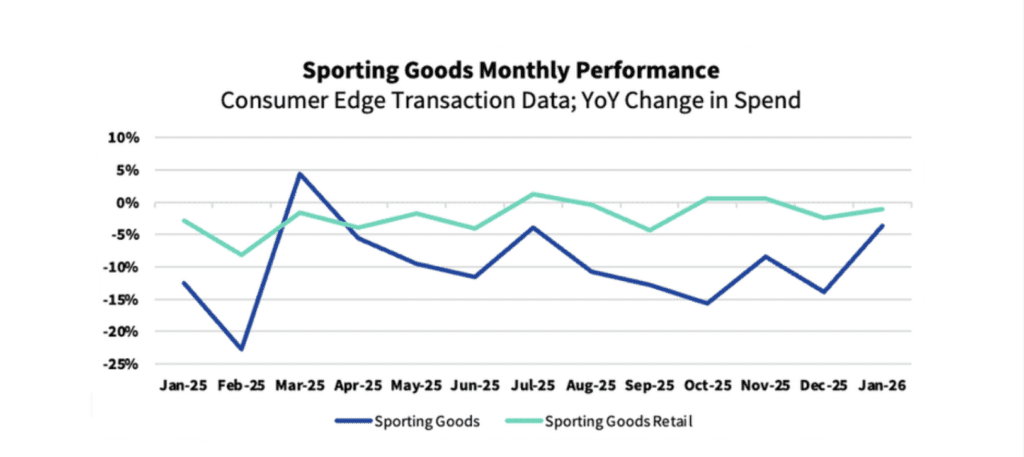
Consumer Edge, the leading provider of global consumer data-driven insights, today released its Sporting Goods Outlook 2026, revealing that the sector’s growth slowed in 2025 after several years of elevated outdoor participation and category growth. U.S. transaction data shows sporting goods spending declined by 9 percent year-over-year in the three months ended January 2026, as tariffs, inflation and pressure on middle-income consumers weighed on discretionary purchases.

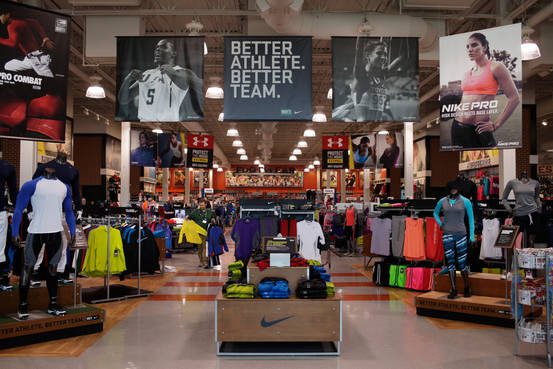
Even as overall sporting goods spending slowed, experiential retail gained traction, with stores such as DICK’S Sporting Goods’ House of Sport attracting shoppers through unique, interactive experiences (i.e., climbing walls, turf fields and other in-store events) that go beyond traditional retail. Outdoor brands also found success by expanding beyond performance gear into everyday apparel and footwear. Brands including Salomon, Rossignol and Evo gained momentum, with their lifestyle positioning resonating especially strongly among consumers in the Northeast and Midwest.

Additional insights include:

Michael Gunther, SVP, Research & Market Intelligence, at Consumer Edge
  • Spending diverged among high- and middle-income shoppers – Higher-income shoppers drove much of the category’s spend-per-customer growth, benefiting retailers and brands serving premium sports such as skiing and golf, including Backcountry, Evo and PGA TOUR Superstore. At the same time, middle-income shoppers pulled back on discretionary sporting goods purchases.
  • Gen Z shoppers are boosting niche sports brands – Consumers aged 18 to 24 recorded the highest spend-per-shopper growth throughout most of 2025, supporting brands tied to specific sports communities such as Epic Sports and Proof Lab.
  • Tariffs are weighing on hunting and fishing retailers – Steel and aluminum tariffs introduced in 2025 likely contributed to double-digit spending declines for companies including Sportsman’s Warehouse, Brownells and Palmetto State Armory.
  • The Western U.S. saw the steepest declines in sporting goods spending – While regional performance varied widely across the U.S., spending in the West dropped the most dramatically in Q1 2025, creating pressure for retailers such as Big 5 Sporting Goods.
  • Store openings are rapidly reshaping local competition – In Tulsa, Okla., the opening of a new SCHEELS store propelled the retailer from no market presence to category share leader within three months, disrupting competitors including Academy Sports + Outdoors and DICK’S Sporting Goods.

“We’re seeing a shift in sporting goods spending,” said Michael Gunther, SVP, Research & Market Intelligence, at Consumer Edge. “While overall category spend has slowed, demand hasn’t disappeared – it’s consolidating around premium experiences, specialized communities and lifestyle-driven brands. Retailers that rely on broad-based discretionary demand are feeling pressure, particularly from middle-income consumers and tariff exposure. Those investing in experiential retail and strong brand identity are most likely to capture growth.”

AI Agent Traffic Jumps 1,300%. ChannelEngine Introduces AI Attribute Builder for the Next Phase of Ecommerce

0

As AI takes center stage at Shoptalk Spring 2026, a deeper shift is unfolding beneath the hype. Shoppers are increasingly finding products through AI assistants and agents. In April, ChannelEngine will launch AI Attribute Builder to help brands ensure their product data is complete and consistent across channels to stay visible as discovery evolves.

Morgan Stanley projects autonomous agents could influence up to $385 billion in U.S. ecommerce spend by 2030. Already, traffic from AI assistants and agents to retail sites has grown more than 1,300% over the past year. The impact is already visible on individual marketplaces: during last year’s Black Friday, Amazon’s AI shopping assistant Rufus drove 40% of sessions and influenced 66% of purchases, delivering a 3.5x conversion lift.

Niels Floors, VP of Strategic Development at ChannelEngine

The systems powering search results, marketplace rankings, and AI-generated recommendations all rely on product data to decide what appears in front of shoppers. Listings with missing identifiers, incomplete specifications, or inconsistent information may still exist online, but they are far less likely to surface when algorithms decide what to show.

“We’re seeing a fundamental shift in what product visibility means. The question used to be: how do I get my products found? Now it’s: how does an AI agent understand them? They don’t browse product pages; they evaluate structured data and decide what to recommend. Missing or inconsistent attributes don’t just hurt rankings. They take products out of the running entirely.” — Niels Floors, VP of Strategic Development at ChannelEngine.

Introducing AI Attribute Builder

In April, ChannelEngine will launch AI Attribute Builder, a new capability that helps brands generate, enrich, and standardize product attributes to meet the specific requirements of each channel they sell on. This covers everything from complete specifications and descriptions to product identifiers that AI agents can read, assess, and recommend.

Protocols like Google and Shopify’s Universal Commerce Protocol (UCP) and OpenAI’s Agentic Commerce Protocol (ACP) are already defining how AI agents access and interpret product information. The more complete that information is, the more likely a product gets selected.

Jorrit Steinz, CEO and Founder of ChannelEngine

ChannelEngine helps brands manage product data, pricing, inventory, and orders across hundreds of channels from one place. AI Attribute Builder extends this with product data enrichment to meet the growing demands of both marketplaces and AI-powered commerce.

“Clean, complete, consistent data has always mattered for marketplace success,” said Jorrit Steinz, CEO and Founder of ChannelEngine. “What’s changing is who’s reading it. Today it’s marketplace algorithms. Tomorrow it’s AI agents influencing purchasing decisions. The brands that get their product data right now will be the ones that stay visible.”

Upcoming Events