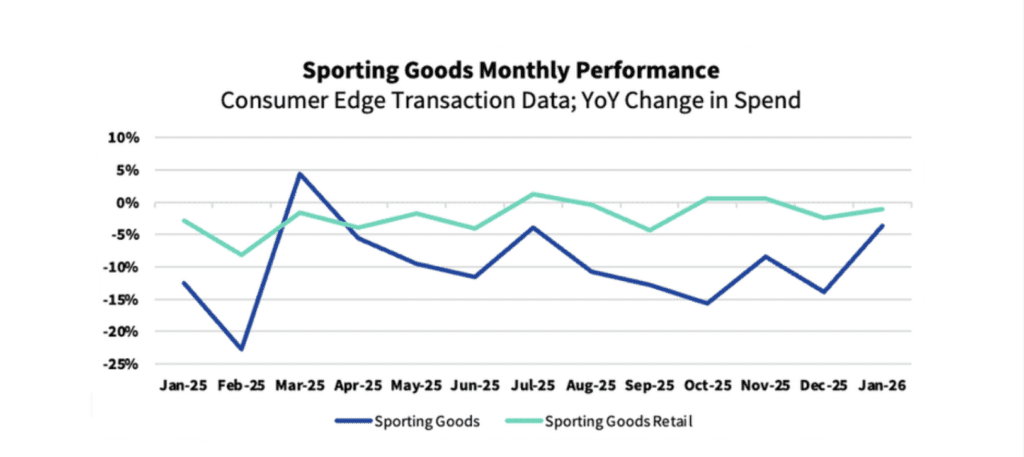
Consumer Edge, the leading provider of global consumer data-driven insights, today released its Sporting Goods Outlook 2026, revealing that the sector’s growth slowed in 2025 after several years of elevated outdoor participation and category growth. U.S. transaction data shows sporting goods spending declined by 9 percent year-over-year in the three months ended January 2026, as tariffs, inflation and pressure on middle-income consumers weighed on discretionary purchases.
Even as overall sporting goods spending slowed, experiential retail gained traction, with stores such as DICK’S Sporting Goods’ House of Sport attracting shoppers through unique, interactive experiences (i.e., climbing walls, turf fields and other in-store events) that go beyond traditional retail. Outdoor brands also found success by expanding beyond performance gear into everyday apparel and footwear. Brands including Salomon, Rossignol and Evo gained momentum, with their lifestyle positioning resonating especially strongly among consumers in the Northeast and Midwest.
Additional insights include:

- Spending diverged among high- and middle-income shoppers – Higher-income shoppers drove much of the category’s spend-per-customer growth, benefiting retailers and brands serving premium sports such as skiing and golf, including Backcountry, Evo and PGA TOUR Superstore. At the same time, middle-income shoppers pulled back on discretionary sporting goods purchases.
- Gen Z shoppers are boosting niche sports brands – Consumers aged 18 to 24 recorded the highest spend-per-shopper growth throughout most of 2025, supporting brands tied to specific sports communities such as Epic Sports and Proof Lab.
- Tariffs are weighing on hunting and fishing retailers – Steel and aluminum tariffs introduced in 2025 likely contributed to double-digit spending declines for companies including Sportsman’s Warehouse, Brownells and Palmetto State Armory.
- The Western U.S. saw the steepest declines in sporting goods spending – While regional performance varied widely across the U.S., spending in the West dropped the most dramatically in Q1 2025, creating pressure for retailers such as Big 5 Sporting Goods.
- Store openings are rapidly reshaping local competition – In Tulsa, Okla., the opening of a new SCHEELS store propelled the retailer from no market presence to category share leader within three months, disrupting competitors including Academy Sports + Outdoors and DICK’S Sporting Goods.
“We’re seeing a shift in sporting goods spending,” said Michael Gunther, SVP, Research & Market Intelligence, at Consumer Edge. “While overall category spend has slowed, demand hasn’t disappeared – it’s consolidating around premium experiences, specialized communities and lifestyle-driven brands. Retailers that rely on broad-based discretionary demand are feeling pressure, particularly from middle-income consumers and tariff exposure. Those investing in experiential retail and strong brand identity are most likely to capture growth.”