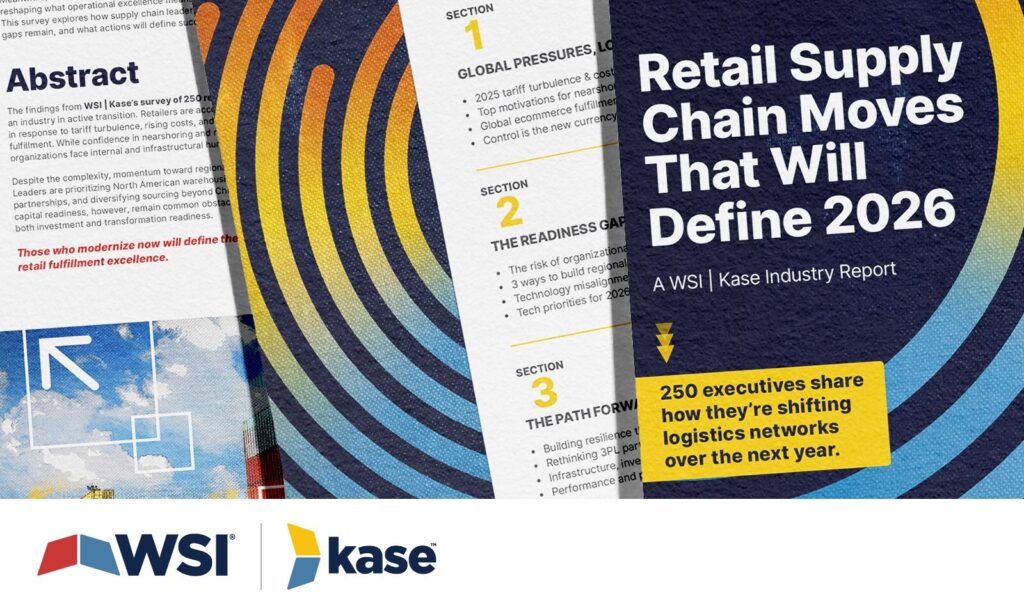
WSI (Warehouse Specialists, LLC) and Kase, in collaboration with independent research firm TrendCandy, have released Retail Supply Chain Moves That Will Define 2026. This timely survey captures insights from 250 retail supply chain leaders on how they’re adapting to tariff turbulence, nearshoring and reshoring trends, and rising expectations for delivery speed and control.

The report unveils a sector in rapid transformation. Nearly every respondent (94%) said recent tariff increases have accelerated their supply-chain decision-making, while 91% acknowledge tariff volatility has already prompted a reevaluation of supplier geography. Yet only 21% feel their logistics networks are truly equipped for regional fulfillment, signaling a readiness gap even as momentum toward regional models intensifies.
“Retailers are balancing urgency with pragmatism,” said Peter Davis, Senior Vice President for Commercial Operations at WSI | Kase. “They’re diversifying sourcing, piloting nearshore operations, and rethinking 3PL partnerships—but capital, technology, and resilience remain the biggest variables.”
Regional resilience replaces cost-first thinking
The data shows the industry is shifting from cost-centric strategies to resilience-centric design.
- 77% of leaders report sourcing has already shifted away from China toward tariff-neutral countries.
- 93% are expanding warehousing in the U.S. or Mexico to strengthen regional fulfillment.
- 84% expect to restructure 3PL partnerships by 2026, as only 58% feel confident their current providers can handle major strategic shifts.
Control emerges as the new currency
Beyond sourcing, leaders are prioritizing control, visibility, and technology integration as competitive differentiators.
- 88% of respondents say transparency on supply chain changes strengthens customer loyalty.
- 84% encounter IT alignment challenges, reinforcing that agility without visibility is fragility.
WSI | Kase’s research highlights that technology alignment and capital readiness now define supply-chain agility, not just geography. The survey illustrates how retailers are blending nearshore expansion, digital infrastructure, and collaborative partnerships to achieve lasting resilience.
A full-spectrum perspective on logistics transformation
As a powerhouse in modern logistics, WSI | Kase combines decades of 3PL and warehousing expertise with advanced fulfillment technology to deliver true end-to-end performance. Together, they support everything from manufacturing and niche storage to ecommerce fulfillment and transportation, providing the stability and visibility today’s brands need to stay competitive. Their collaboration with TrendCandy brings quantitative rigor and data-driven industry insight into one of the industry’s most urgent transformations.
“This data gives leaders a roadmap for measured transformation,” added Davis. “It’s not just about moving faster…it’s about finding actionable strategies to actually move the ball downfield.”