
Customers have more options than ever before. Just think – if you want a chicken sandwich, you can easily go to no less than 10 limited-service restaurant brands; if you want automotive insurance, you can probably name several brands you might reach out to without doing any additional research. With nearly endless options, regardless of service or product, how do customers choose?
In an increasingly crowded marketplace, the key to differentiation is clear: delivering a great experience is the great brand unlock.
Delivering a great experience is not as simple as it once was. It now requires brands to provide several great experiences across their customer touchpoints – every time, for every customer. Pulling that off is easier said than done.
When brands are successful, they see increased market share and overall better financial performance, with evidence in abundance. But what’s the roadmap for brands to see this kind of success? It starts with measuring and managing the full experience journey.
Digital Experience
As more brands invest in their digital channels, customer expectations for how their websites, apps, and chatbots function continue to rise. Competitive benchmarking can be a great starting point for improving digital experiences. It offers insight across five key dimensions:
• Operability – this app / website works well
• Learnability – this app / website is easy to understand
• Product fit – this app / website has what I need
• Inspiration – this app / website inspires me to connect or transact with this brand
• Design appeal – this app / website looks good
A great user experience audit can identify the current pain points along your digital journey, identify how your competitors are addressing those challenges and set a clear path for how to reduce friction and build trust with your customers.
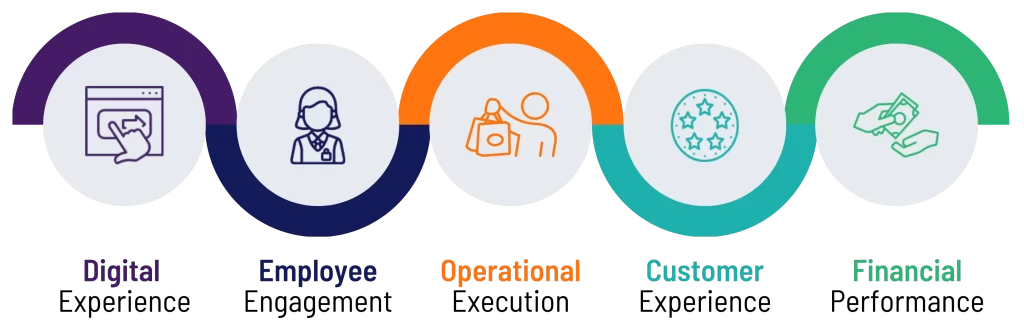
Employee Engagement
Employees are the face of your brand – it’s impossible to deliver great experiences without them. Understanding how your people feel about the business and what might be done to build their advocacy is foundational to enabling them to deliver on your brand promise.
These are the two areas critical to understanding employee experience:
Employee Engagement. What does your brand mean to your employees? Are they connected to your brand mission? What can be done to increase their sense of loyalty and belonging within the business?
Employee Enablement. Do your team members have the tools, training, resources and flexibility to deliver on your brand promise and take immediate action to convert a bad customer interaction into an excellent one?
Winning choice today is less about louder messaging and more about earning relevance, trust, and emotional permission in decisive moments.
Operational Execution
How do you “inspect what you expect” across every aspect of your operation? Both operational audits and mystery shops allow brands to objectively assess if brand standards are consistently met. These services can enable real-time measurement and management of:
People – how do your team members engage customers? Do they smile? Make eye contact? Use customer’s names? Are they wearing the right apparel?
Process – do your front-line team members follow prescribed steps of sales and service?
Pricing – are your products or services priced the way that you have intended? Are those prices evident and clear to the customer?
Promotion – are your promotions run effectively? Does the customer know that there is a sale? Is the discounted offer clearly conveyed?
Customer Experience
While measuring actual execution is important, it is equally important to understand how those levels of consistent delivery (or lack of performance) make the customer feel. For that insight, brands turn to customer experience measurement programs. There are two core modes of customer feedback – solicited and unsolicited.
Solicited – these are customer satisfaction / experience surveys that can be offered in your stores, on your website, in your apps, and emailed or texted to your customers. This subjective feedback offers insight into how customers feel: how overall satisfied they are with you, how likely they are to return to you, and how likely they are to recommend you to others.
Unsolicited – What do customers have to say when you aren’t asking them for feedback? This is where social media monitoring comes in. Star ratings, comments and reviews clearly identify pain points and offer rich customer recovery opportunities.
Data, Data, Data
It will come as no surprise that implementing these various measures produces a lot of raw data – data on your people, data on their performance, and data from your customers. Data is powerful, but it has to be:
Organized: Are your data streams connected and speaking to one another, or are they siloed?
Democratized: Can everyone in the organization access the data, and are they empowered to act upon it?
Actionable: Are you able to translate that data into next steps for your organization? When changes are implemented, are you equipped to measure the ROI of the corrective actions taken to improve experience?
Understanding how investments in experience contribute to the overall business success allows brands to refine strategies and allocate resources more effectively. Ipsos’ ROXI (Return on Experience Investment) analytics and insights solution provides a comprehensive approach to understanding and quantifying this impact. By integrating experience measurement data with financial performance metrics, ROXI empowers brands to precisely calculate the value that experience investments and improvements bring to their business. This evidence-based approach enables decision-makers to justify investments in customer experience initiatives and demonstrate their tangible returns.
Ipsos stands out as a unique partner in the landscape of experience design, measurement, and management. By offering end-to-end solutions built on robust methodologies like ROXI, Ipsos equips brands with the strategic insights and actionable recommendations to create and sustain exceptional customer experiences. These tailored services ensure that every step, from strategy development to execution, is informed by data-driven insights that maximize business outcomes.