
For years, companies have worked to make their websites, apps, stores and sales channels better at winning customers. They’ve invested in personalization, recommendations and smoother transactions. Much of today’s AI investment follows the same logic.
But what happens when the customer has already made up their mind before arriving?
For brands accustomed to shaping the buying journey through their own channels, that’s a significant change. They have less visibility into how customers compare their products and why selections were made or competitive brands were chosen.
AI assistants are owning product comparison, evaluation of alternatives and final recommendations. Customers are making purchasing decisions before visiting a brand’s website or speaking with its sales team. The company may never know which competitors were considered or why their products weren’t chosen.
The Customer Journey Is Starting Outside the Brand
SAP recently published the AI in Customer Experience Report, which surveyed 4,800 consumers and CX professionals in the United States and Germany. The U.S. findings suggest this shift is already underway: half of American consumers say they use AI in at least some purchasing journeys.
AI is making it easier for customers to compare products and brands, while giving retailers less say in how they’re evaluated.
Companies have spent decades earning trust through product quality, expertise, service and reputation. Those investments remain valuable. The question is whether AI can recognize them.
Imagine two department stores with similar products and prices. One has a long record of dependable service, knowledgeable people and a reputation for handling problems well. The other looks comparable on paper. Will an AI assistant understand the difference? What information will it use to decide?
Brands cannot control how every AI assistant evaluates them. But they can make the evidence behind their differences clearer. For the department store with a stronger service record, that means going beyond a claim of “great service”: making its support commitments, relevant expertise and customer results accessible alongside accurate product, pricing and availability information. Those details give buyers—and the AI helping them—more to evaluate than whether two products look alike.
The goal is not simply to make a brand easier for AI to find. It is to make the reasons to choose it easier to understand. Brands need to become easier to compare without becoming easier to replace.
That requires a different starting point for AI investment: not just how the business can recommend more effectively, but how it can help AI evaluate and recommend more confidently.
Among the capabilities tested, consumers ranked price comparison and discount application first. Personalized recommendations came sixth. CX decision makers, by contrast, ranked personalized recommendations first among their priorities, while price comparison and discount application came seventh.
The distinction matters. Personalized recommendations can help customers find relevant options. But customers are also asking AI to help them judge those options. A brand’s expertise, service and reliability matter when customers can understand what those strengths mean for their own purchase. Helping them compare value is not the same as competing on price alone.
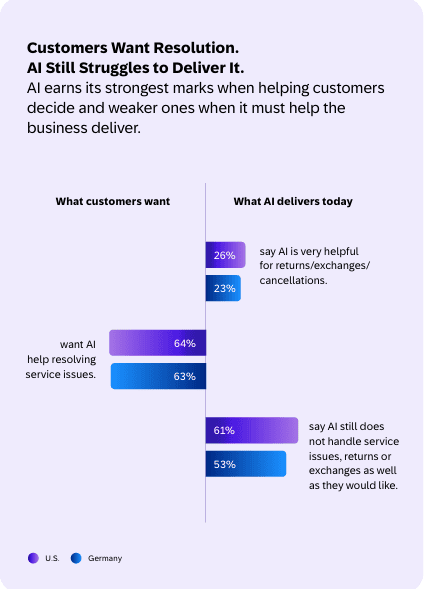
And it’s not just a question of what customers want AI to do, but how much control they’re willing to give it. Even in a hypothetical future where AI could reliably anticipate needs and manage purchases, the SAP AI in Customer Experience Report indicated that 87% of U.S. consumers say they would still want to review and approve every purchase.
Being Recommended Is Only Half the Challenge
Making a brand easier for AI to discover and evaluate is an important first step. But companies also need to deliver on the expectations those interactions create. A customer might find the right product through an AI assistant, only to encounter inaccurate availability information, a delayed order or a service experience that requires starting over.
Surfacing the right information to AI for discovery requires coordination that many businesses haven’t fully achieved. While 93% of U.S. CX decision makers consider their organizations at least somewhat prepared to serve customers using AI agents, 78% are not fully prepared to connect the customer-facing and operational systems needed to coordinate the entire journey.
We call this the Autonomy Gap: the distance between what AI can do, what customers are willing to delegate and what businesses are prepared to deliver.
Prepare for the Customer, Not Just the Channel
I recommend retailers start by looking at your brand through the eyes of an AI assistant. Can it understand what makes your company different? Does it understand what makes your products unique? Can it discover your pricing and recognize the expertise, service and value that give customers a reason to choose you? If not, focus on enhancing your digital merchandising and marketing content, your catalogue and your website. Invest in building the volume and quality of detailed third-party reviews. Social proof is one of the clearest signals AI can interpret when evaluating brand credibility and customer satisfaction.
Then consider what happens when customers move from those AI interactions into your own channels. Are you giving them a reason to engage directly? Can they pick up where they left off? Can your business deliver on the expectations that brought them there? Most importantly, the space where customers build trust and loyalty is still yours to own. Focus on creating differentiated experience that builds loyalty during and post-purchase. Delight customers in the moments where your direct relationship gives you an advantage, so customers turn to you for their next purchase instead of AI for a fresh recommendation.
The brands that succeed won’t simply be the ones that are easiest for AI to find. They’ll be the ones that remain relevant and differentiated throughout the customer journey, regardless of where it begins.
Customers will decide where they begin. Businesses still have considerable influence over what happens next.
Read the AI in Customer Experience 2027 Report: The Autonomy Gap HERE
With over a decade of experience at SAP, Jessica Keehn currently serves as Chief Marketing Officer at SAP Customer Experience, bringing expertise in commercialization, product strategy, operations, and cross-functional team leadership. She collaborates with teams to build and execute strategies that align with SAP’s mission to deliver exceptional customer experiences.